


Phases and Management of Medical Device Clinical Investigations
Unlike drug trials, medical device Clinical Investigations (CI) are not typically divided into phases. However, the process of collecting the clinical evidence required by the MDR can be logically separated into stages based on the device’s development phase. These stages aim to progressively prove the device’s safety and performance.
Stage | Objective | Focus |
Early Feasibility | To confirm that the basic design and operating principle of the device are safe in humans. | Small number of patients, short-term follow-up, basic safety data. |
Pivotal Study | To statistically prove that the device provides the intended clinical benefit and is safe. | Sufficient number of patients, long-term follow-up, primary and secondary efficacy/safety endpoints. |
Post-Market (PMCF) | To monitor the long-term safety and performance of the device in real-world conditions. | Large number of patients, follow-up long lasting, detection of rare adverse events. |
The Key to Success in Clinical Investigation Management
A successful clinical investigation is not only scientifically sound but must also be regulatory flawless. Critical success factors in the management process include:
- Strategic Planning (CIP): Designing the investigation to target the specific GSPRs (General Safety and Performance Requirements) needed for the CER.
- Regulatory Speed: Managing the Ethics Committee and Competent Authority (TİTCK) approval processes without error.
- Data Quality: Full compliance with ISO 14155 (GCP) standards and the use of reliable data collection systems.
Speed, Efficiency, and Cost Management in MDR Processes
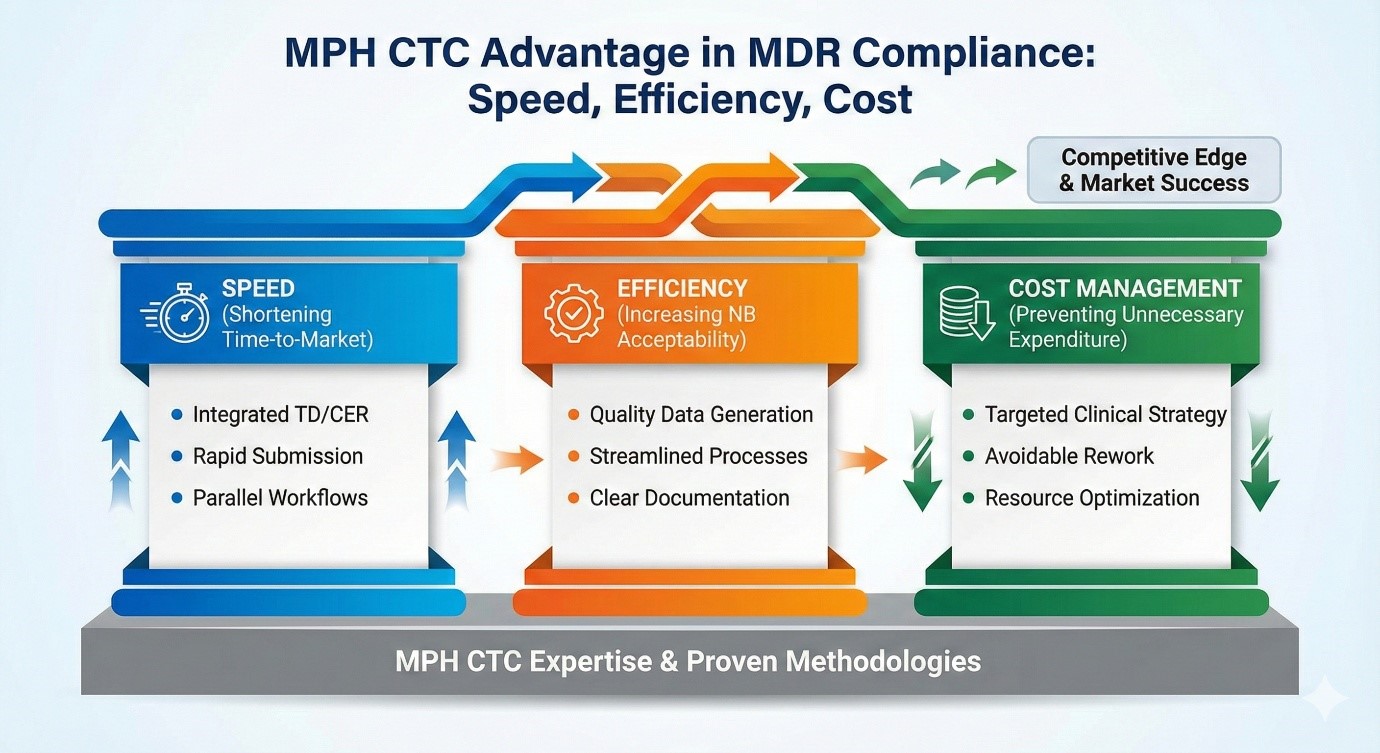
MDR compliance process is complex, time-consuming, and costly. At MPH CTC, we focus on three core pillars that provide manufacturers with a competitive advantage in this challenging environment: Speed, Efficiency, and Cost Management.
- Speed: Shortening Time-to-Market
Delays in regulatory processes mean missed opportunities for market entry. Our key strategies for speed advantage are:
- Rapid Application Management: Medical support in preparing Ethics Committee applications to be approved on the first attempt, thanks to our full mastery of TİTCK regulatory requirements (protocol preparation, sample size selection).
- Large Pool of Volunteers: Large patient population from various medical branches to keep patient recruitment fast
- Efficiency: Increasing Data Quality and Acceptability
- GCP Expertise: Conducting all clinical investigations of medical devices, in compliance with internationally recognized ISO 14155 (GCP) standards.
- CER-Focused Design: Designing studies to prove the specific clinical endpoints required by the CER.
- Expert Team: Managing every stage of the process with our experienced team of regulatory experts, biostatisticians, and clinical research coordinators.
- Cost Management: Preventing Unnecessary Expenditure
- Correct Classification and Strategy: Avoiding unnecessary NB audits or the burden of collecting excessive clinical data by ensuring correct risk classification from the outset.
- One-Centered Solution: Offering clinical investigation, regulatory consulting, and medical writing services under one roof to reduce coordination costs.
References
[1] Regulation (EU) 2017/745 of the European Parliament and of the Council of 5 April 2017 on medical devices, Annex XV.
[2] ISO 14155:2020 Clinical investigation of medical devices for human subjects — Good clinical practice.
[3] MDCG 2020-5 Guidance on clinical evaluation – equivalence.European Commission.